




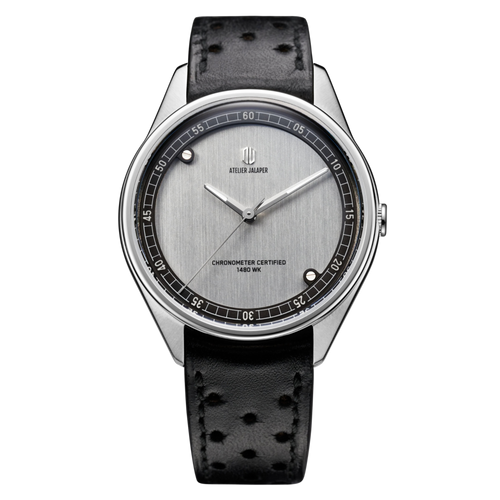
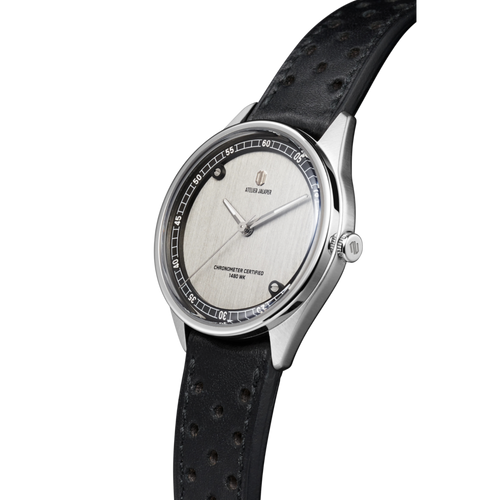
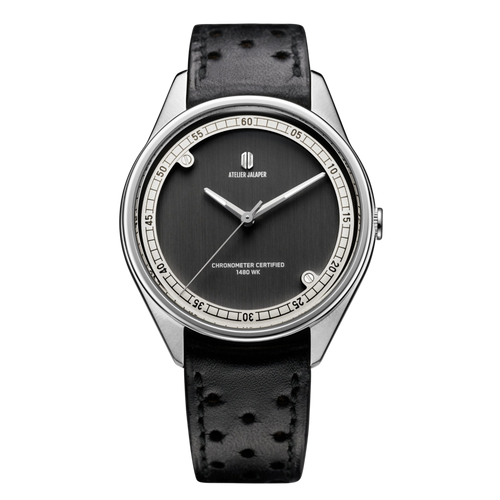
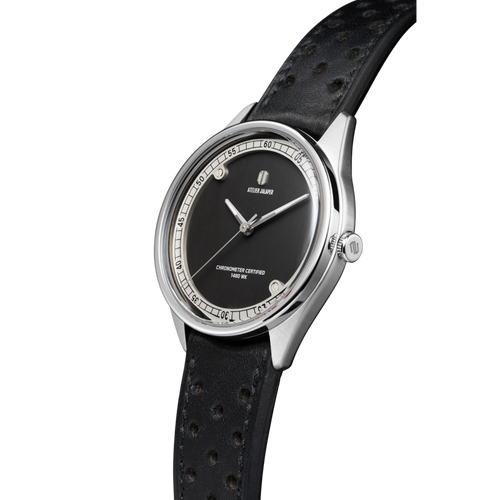
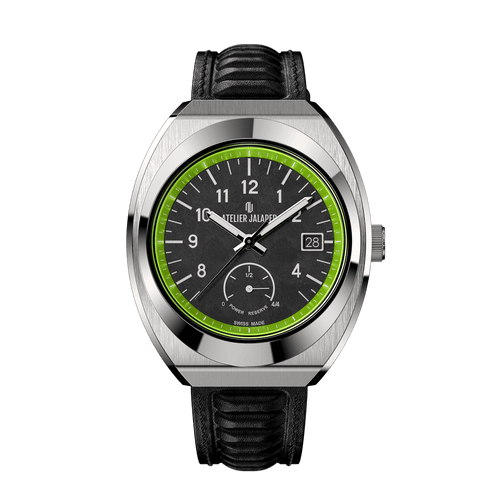
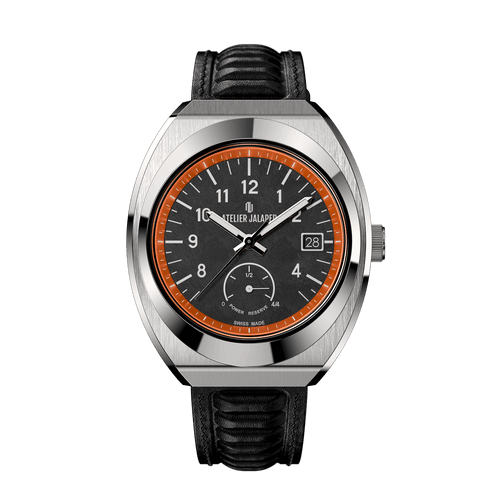
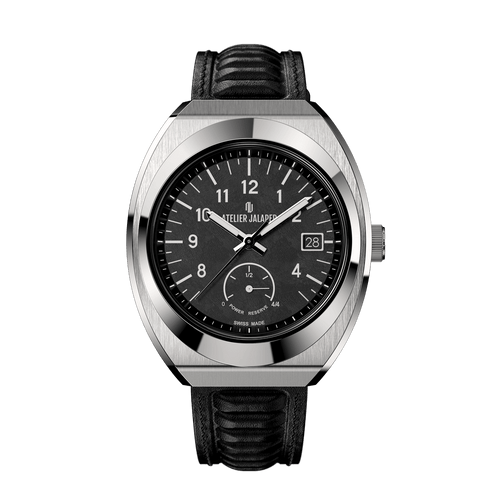
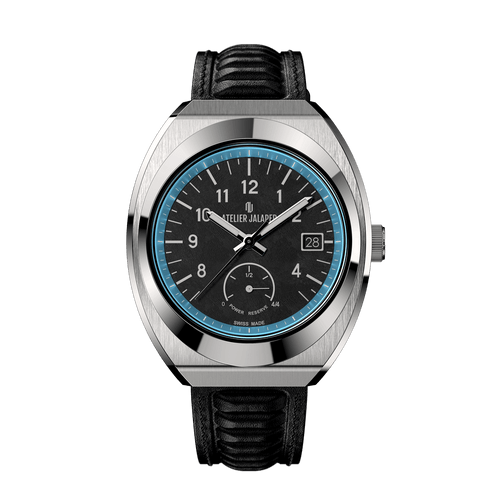
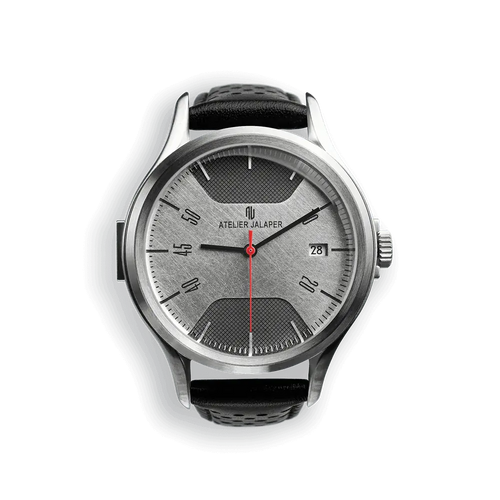
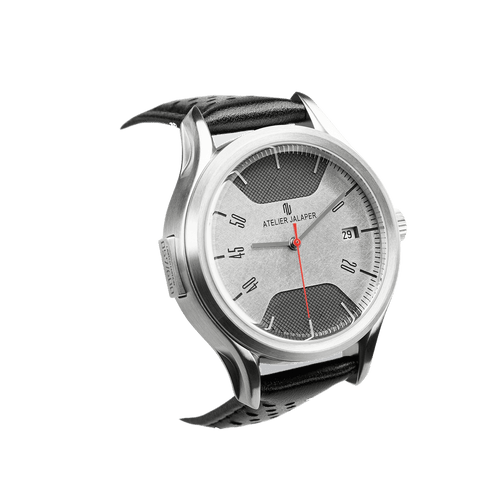
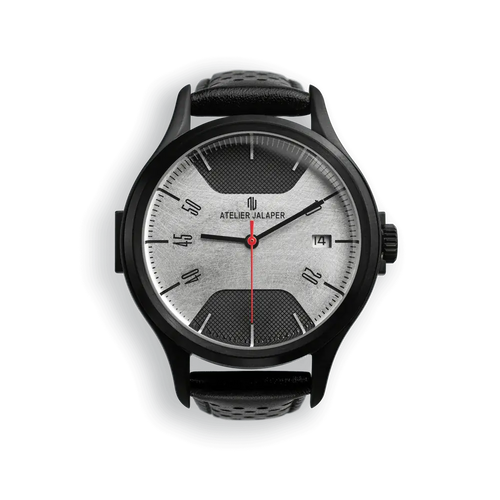
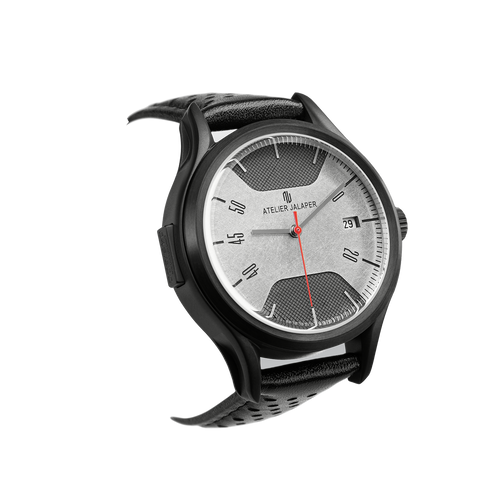

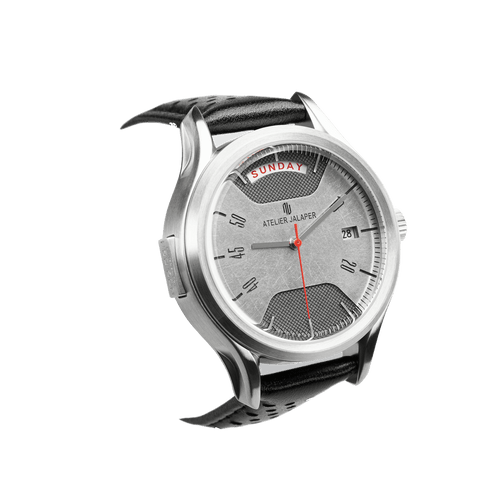
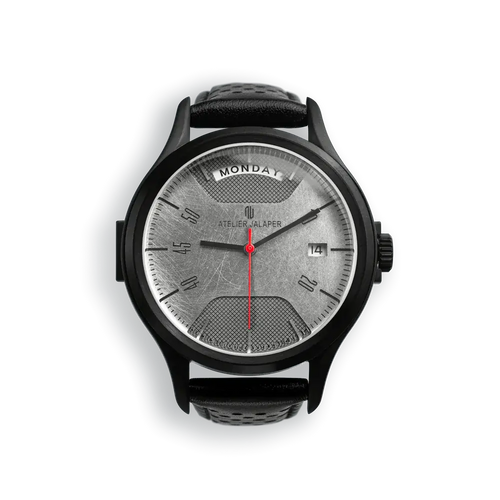
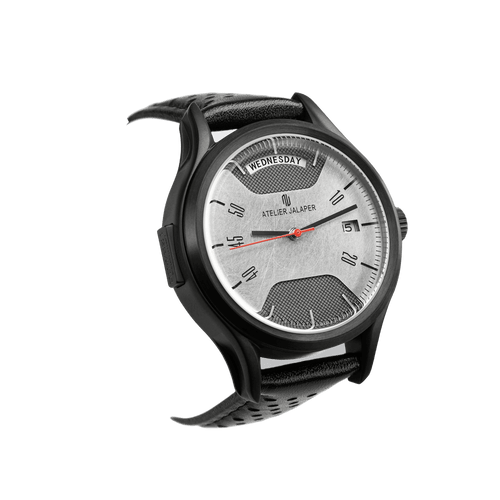



How does your AJ-003 automatic watch work ?
Understanding how your AJ-003 automatic watch works helps you look after it properly and know what to expect day to day. Unlike a quartz watch, there's no battery driving the mechanism: it's the movement of your wrist that winds the spring and keeps the hands turning.
How automatic winding works
Inside the case of your Type E collection watch sits a rotor, a semi-circular metal weight that pivots freely with each movement of your arm. This rotor gradually winds the mainspring, which then releases that energy steadily to advance the hands. The more you wear the watch during the day, the more the spring stays charged.
The movement: Sellita SW300-1B
The AJ-003 uses a Sellita SW300-1B calibre, an automatic movement certified by the COSC (Contrôle Officiel Suisse des Chronomètres). It beats at 28,800 vibrations per hour (4 Hz) and offers a power reserve of around 56 hours when fully wound. The rotor is skeletonised and bevelled, with Côtes de Genève finishing and a 3N gold galvanic treatment, visible through the screwed caseback.
COSC certification means the movement has been tested individually before casing, following a strict protocol that requires a daily accuracy of between -4 and +6 seconds for an automatic calibre, measured across multiple positions and temperatures. It distinguishes this calibre from a standard uncertified movement. Each AJ-003 comes with the COSC certificate specific to its movement, so you can check the test results for your watch. For the full case and movement figures, see our technical specifications.
Available functions
This calibre displays hours, minutes, and seconds, with a hacking seconds function: pull the crown and the second hand stops, letting you synchronise the time to the exact second. There's no date function on this movement, a deliberate choice that keeps the dial clean and true to the instrument-panel feel of the 1962 Jaguar Type E Semi-Lightweight.
What happens if you stop wearing it
If you leave the watch unworn for several days, the spring will eventually run down once the 56-hour power reserve is exhausted and the watch will stop. This isn't a fault: wind it back up, manually or by wearing it again, then set the time before putting it back on. Our guide to winding your automatic watch explains how to restart it without forcing the crown.
Accuracy and movement servicing
Like any mechanical movement, the AJ-003 calibre may gain or lose a little time from one day to the next, depending on how you store the watch and your activity level. This is normal within the limits set by COSC certification. If you notice a larger variation that persists over several weeks, or if the watch stops before reaching its usual power reserve, that may be a sign a service is needed. Our guide to servicing the movement explains when and why to consider it.
The characteristic 4 Hz tick
Hold the watch close to your ear and you'll hear a faint, rapid ticking: that's the SW300-1B's 28,800 vibrations per hour. This higher frequency also gives the second hand its smooth, near-continuous sweep rather than the sharp jump of a quartz watch. Through the screwed caseback, you can watch the skeletonised rotor turn with each movement of your arm, a small detail many owners come to appreciate over time.
The hacking seconds function has a practical use day to day too. Before an important meeting or a trip where the exact time matters, you can resynchronise the watch to your phone in seconds rather than living with a small drift that has built up since the last adjustment.
In summary
Your AJ-003 runs on a simple principle: wrist movement keeps the spring wound, a COSC-certified Sellita SW300-1B turns that energy into precise timekeeping, and a hacking seconds function lets you set the time exactly. For your first steps after receiving the watch, see our getting started guide.
Frequently asked questions
How long does an automatic watch run without being worn?
The Sellita SW300-1B offers around 56 hours of power reserve when fully wound. Once that's used up the watch stops, but this isn't a fault. A few turns of the crown will restart it; then set the time before putting it back on.
What's the difference between an automatic and a quartz watch?
A quartz watch runs on a battery and a crystal oscillator, giving it high accuracy (around ±15 seconds per month) with no regular maintenance. An automatic watch is entirely mechanical: wrist movement winds the spring, with no battery. It needs periodic servicing, but the movement can last several decades with proper care.
What is COSC certification?
The COSC (Contrôle Officiel Suisse des Chronomètres) is an independent body that tests each movement individually before casing. For an automatic, certification requires accuracy between -4 and +6 seconds per day, measured over 16 days in multiple positions and temperatures. It's a demanding standard applied only to movements already selected for their quality.
Do you need to wind an automatic watch every day?
Not if you wear it regularly. The rotor keeps the spring wound as long as you're moving your arm. Manual winding via the crown is only needed if the watch has stopped after sitting unworn, or if you want to give it a full charge before putting it on.
Is an automatic movement more fragile than a quartz movement?
Not fragile, but more susceptible to certain conditions : hard knocks, magnetism, and extreme temperature changes can affect accuracy. In return, it's fully repairable and can last decades with regular servicing, where a quartz movement will eventually become obsolete once parts are no longer available.
Can you wind an automatic watch by hand?
Yes. The Sellita SW300-1B can be wound manually via the crown in addition to the automatic winding by the rotor. This is useful first thing in the morning if you want to start the day with a full power reserve, or to restart the watch after it has stopped.